
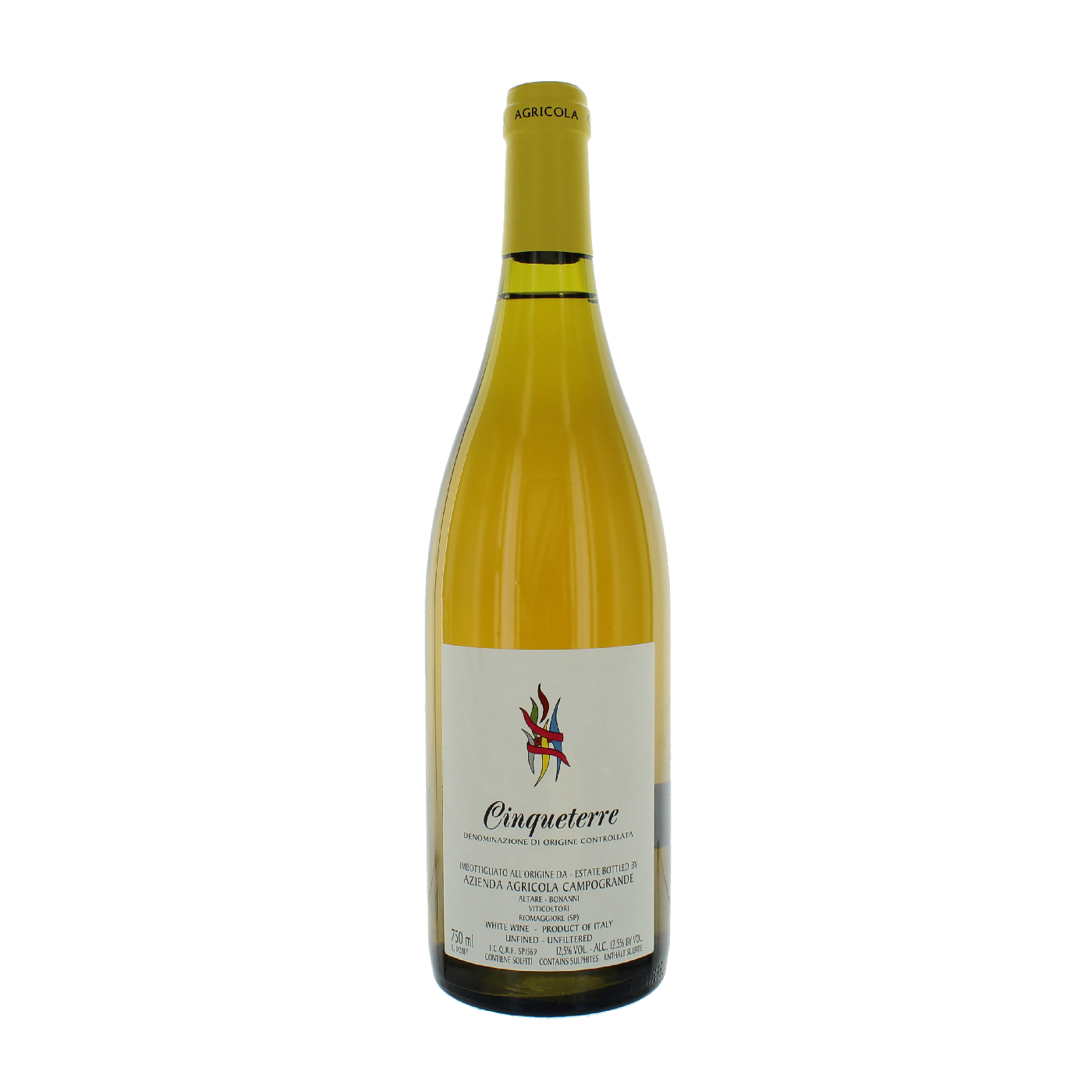
Campogrande Cinqueterre D.O.C. Cinqueterre 2010
Cinqueterre Bianco D.O.P. · Liguria · 2010
46,00€
The Campogrande Cinqueterre D.O.C. Cinqueterre 2010 is a white wine from Liguria, produced with Albarola and Bosco grapes. Its artisanal vinification and the absence of chemical interventions enhance its complexity and longevity.
Available: 15
Technical sheet
- Region
- Liguria
- Denomination
- Cinqueterre Bianco D.O.P.
- Producer
- Campogrande (Altare-Bonanni)
- Harvest Year
- 2010
Description
Campogrande Cinqueterre D.O.C. Cinqueterre 2010
Elio Altare is having fun. With a project called Campogrande, in one of the most incredible terroirs, and one of the hardest to work, in the whole peninsula, the Cinque Terre.
The Cinque Terre Bianco DOC 2010 by Campogrande (signed by Elio Altare) is a cult bottle for lovers of mature whites and heroic viticulture. The 2010 vintage was one of the best of the millennium for Ligurian whites, marked by a cool climate that preserved exceptional acidity, essential for the longevity of this wine.
It is a wine that has evolved towards a fascinating, profound complexity.
The winemaking of the Cinque Terre Bianco DOC 2010 by Campogrande faithfully reflects the philosophy introduced by Elio Altare in Riomaggiore: an artisanal, rigorous approach based on “subtraction”, aimed at letting only the land and the grape variety speak, without the use of wood or invasive chemical interventions.
Here is how this wine was made in the cellar:
1. The Manual Harvest
The grapes (mainly Bosco and Albarola, with a very small balance of Vermentino) are picked by hand on the steep terraces overlooking the sea. As this is heroic viticulture, the bunches are laid in small 15 kg crates and carried on the shoulders (or by the famous monorail trains) to the cellar to guarantee the absolute integrity of the berries.
2. Destemming and Skin Maceration (Skin Contact)
Once in the cellar, the grapes are destemmed and gently crushed. At this point begins the key phase that gives this wine its extraordinary longevity:
• The must remains in contact with the skins for about 4 days in stainless steel tanks.
• This brief maceration (a technique typical of orange wines but used here in a controlled, short way) allows the natural tannins, antioxidants and aromatic precursors to be extracted from the thick skins of the Bosco grape, protecting the wine over time and giving it its typical, almost “masked red” structure.
• The temperature is controlled to prevent fermentation from starting too tumultuously.
3. Spontaneous Fermentation
When the 4 days of contact are over, the wine is drawn off the skins (the separation of the liquid from the skins). The free-run must continues its alcoholic fermentation, which takes place entirely spontaneously thanks to the indigenous yeasts present on the bloom of the berries. No laboratory-selected yeasts are used, nor are enzymes or fermentation activators added.
4. Ageing in Steel
Unlike its older brother Telemaco, which matures in barrique, the classic Cinque Terre by Campogrande spends its entire journey in stainless steel tanks.
• The choice of steel is fundamental: it preserves the purity of the acidic thrust and the pronounced marine salinity of the territory, preventing toasty or woody notes from interfering with the wine’s mineral character.
• The wine remains in contact with its fine lees (the spent yeasts) for several months before bottling, undergoing periodic bâtonnage (gentle stirring) to gain richness and natural stability.
5. “Clean” Bottling
Before bottling, the wine undergoes minimal stabilisation and a very small quantity of sulphites is added. It is neither fined nor invasively filtered, which is why, 16 years on, you may find a very slight natural sediment at the bottom of the bottle, a sign of absolute genuineness.
Appearance
The colour has left behind the greenish reflections of youth for a deep straw-yellow hue with intense, brilliant, luminous golden highlights. The brief maceration on the skins (about 4 days) and the density of the wine are immediately apparent from the way it swirls in the glass, leaving thick, heavy legs.
Nose
The nose is in constant evolution in the glass and is dominated by complex tertiary notes:
• The marine imprint: Briny notes, iodine and seaweed blend with a distinct hint of flint and hydrocarbon (similar to great mature Rieslings).
• The aromas of the territory: Mediterranean scrub emerges strongly, with hints of sage and dried medicinal herbs, pine resin and candied citron peel.
• The sweet nuances: On the finish there are hints of orange blossom honey and ripe yellow-fleshed fruit (loquat, dried apricot).
Palate
It is on the palate that the 2010 shows all its gastronomic greatness:
• The attack: It is dry, warm and of great structure (thanks to the prevalence of the Bosco grape).
• The progression: Despite the years, the acidic backbone is still vibrant and straight. It cuts through the softness of the wine and supports the sip.
• The finish: Very long, almost endless, dominated by an impressive savoury, marine trail. It leaves the mouth clean and taut, with a characteristic slightly almondy finish, typical of the variety.
How to serve it at its best
• Temperature: Do not serve it too cold. The ideal temperature is around 12°C – 14°C. If too cold, the tertiary aromas and complexity would be numbed.
• Glass: Use a large glass (such as one for great Burgundy or important whites).
• Pairing: Avoid light little fish. This 2010 demands structured dishes: a fine sea bass or sea bream baked with potatoes and aromatic herbs, traditional Ligurian first courses with pesto rich in garlic and pine nuts, or medium-aged semi-hard cheeses.
Frequently asked questions
What is the ideal serving temperature for the Campogrande Cinqueterre D.O.C. Cinqueterre 2010?
To fully enjoy the Campogrande Cinqueterre D.O.C. Cinqueterre 2010, it is advisable to serve it chilled, at a temperature of around 10-12°C. This allows its aromas and complexity to shine. Use white wine glasses to ensure good oxygenation and fully appreciate its organoleptic characteristics.
How should the Campogrande Cinqueterre D.O.C. Cinqueterre 2010 be stored?
To preserve the quality of the Campogrande Cinqueterre D.O.C. Cinqueterre 2010, it is important to store it in a cool, dark place, away from heat sources and direct light. The ideal position is horizontal, to keep the cork moist and prevent oxidation. If unopened, it can be stored for several years, thanks to its good acidity.
What food pairings are recommended for this wine?
The Campogrande Cinqueterre D.O.C. Cinqueterre 2010 pairs well with fish dishes, seafood, and light appetizers. Its freshness and complexity also make it an excellent accompaniment for vegetable-based dishes and fresh cheeses. It is ideal for an aperitif, thanks to its versatility and aromatic profile.
What is the winemaking philosophy behind the Campogrande Cinqueterre D.O.C. Cinqueterre 2010?
The vinification of the Campogrande Cinqueterre D.O.C. Cinqueterre 2010 follows a rigorous artisanal approach, without the use of wood or invasive chemical interventions. The grapes are hand-harvested and undergo a brief maceration on the skins, which helps to impart structure and longevity to the wine. This method enhances the typicality of the Cinque Terre terroir and the purity of the grape varieties used.
More wines from Campogrande (Altare-Bonanni)
All winesThe sommelier’s advice
We have personally tasted every one of our wines and know them one by one. We can suggest the right wine for any occasion or the best pairing. Whatever your question, don’t hesitate to get in touch.
Let’s talk about it