
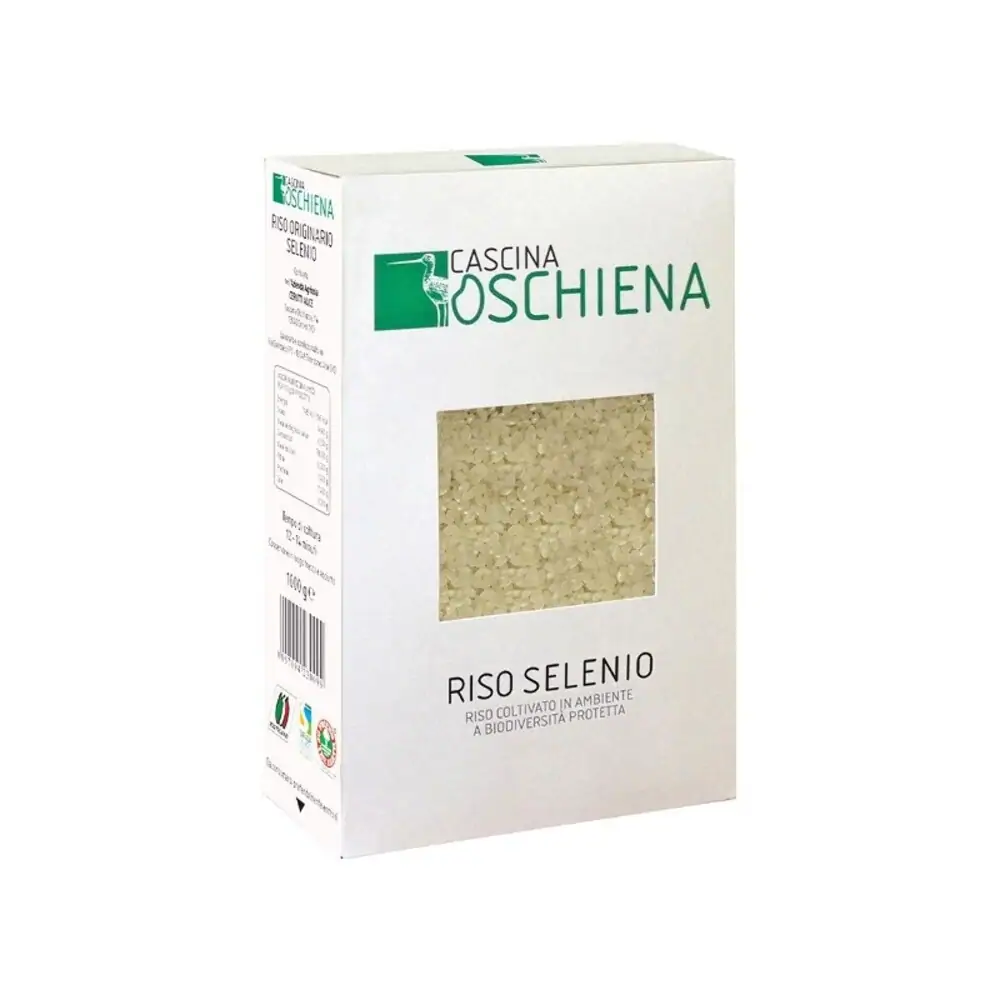
Cascina Oschiena Riso Selenio 1Kg
Riso Selenio · Piedmont
8,00€
Cascina Oschiena's Selenio Rice is a typical organic variety from Piedmont, characterised by small, round grains. Due to its low amylose content, it is soft and sticky, making it ideal for desserts, soups, and Asian dishes.
Available: 10
Technical sheet
- Region
- Piedmont
- Producer
- Cascina Oschiena
- Certification
- Organic, Sustainable Agriculture
Description
Selenio Rice is a historic variety with small, round, crystalline grains.
Given its qualities, its organoleptic characteristics and its low amylose content, Selenio quickly becomes sticky while remaining soft even after cooking.
For this reason it lends itself well to making desserts, soups, broths, sushi and dishes from Eastern culinary traditions.
Cooking time 13-15 minutes.
The philosophy inspiring the farm’s agronomic choices has been, from the beginning, to pursue sustainable agriculture by creating a cultivation system that combines the guarantee of production with the protection of the heritage that belongs to All of Us, namely the Environment.
For this reason we grow our rice following the rules and techniques of integrated production regarding the control, limitation and reduction of fertilisers and plant protection products, and without using insecticides.
We adhere to measure 10.1.2 “Paddy Field Biodiversity” of the Rural Development Plan of the Piedmont Region, which provides for the creation of ditches in the paddy fields to avoid total drying out throughout the year. The ditches are at least 60 cm wide and 40 cm deep to create optimal conditions for aquatic and terrestrial biodiversity: we have created over 10 kilometres of them!
By keeping the paddy fields flooded, especially in spring, settlement is also made easier, including for the nesting of migratory bird species such as Black-winged Stilt, Lapwing, various species of Sandpiper, Ruff, Marsh Sandpiper, Spotted Redshank, and of course the Black-tailed Godwit, the symbol of Our Farm. Throughout the year it is possible to observe the presence of various species of Heron (Grey, White), Bittern, Buzzards, Kestrels, Marsh Owls and Barn Owls.
Winter soil preparation is kept to a minimum in order to reduce erosion and the loss of nutrients caused by rainfall.
During the winter period green manure crops are also sown, that is, plant species that naturally enrich soil fertility: legumes (including clover and vetch) house within their root systems symbiotic bacteria capable of fixing atmospheric nitrogen in a form that rice plants can subsequently use, thus reducing the use of synthetic fertilisers.
The only preparatory work done on the fields in the autumn-winter months is the passage of minimum tillage equipment. This practice avoids turning over the slice of soil and allows the clod to be broken up, mixing it superficially with the rice straw, which is thus made more palatable to bacteria without destructuring the active horizon of the soil.
Towards the end of winter, maintenance is also carried out on the water management infrastructure (canals, ditches, drainage openings between paddy chambers, embankments, etc.).
At the beginning of spring a second minimum tillage pass is carried out, in addition to the ploughing of the plots which, on a multi-year rotation, are levelled to obtain flat surfaces and, consequently, better water management.
The sowing is carried out at the end of April-beginning of May depending on the varieties.
We broadcast-sow in a strictly flooded paddy field, respecting an ancient technique, as opposed to modern dry-sowing techniques: an important ethical, environmental and agronomic choice to safeguard the peculiarities of the rice-growing area and protect biodiversity.
The water together with the soil and the environment that surrounds it are the most precious asset we have.
That is why the flooding of Our Paddy Fields begins in the very first days separating winter from spring; because of our geographical position, closer to the Alpine arc and to the beginning of the rice-growing area, we benefit as much as possible from the first meltwater of the snowfields at the lowest altitudes, thus setting in motion the complex system of the paddy fields which, by dispersing fresh water over vast surfaces, allow it to slow down in its run towards the sea.
From this slowing down comes an exponential increase in the infiltration of water into the shallow aquifer, which is returned by the latter in the springs (fontanili) located progressively further downstream. This alchemy of flow, infiltration and return allows the entire paddy field system to return more water than that used for flooding (about 1 million m³ used against 1.4 million m³ of water returned per agricultural year. Source AIOS agricultural year 2020).
For sowing, as for the other cultivation steps, we use an integrated system of weighing/dosing, GPS guidance and computer PLCs (precision agriculture). These are fundamental techniques for distributing only the necessary quantity of product, thus avoiding waste and an increase in the environmental pressure factors related to agricultural production.
At Cascina Oschiena rice has been grown since the 16th century under the management of the Benedictine Monks. Today our commitment, in the name of tradition, is to keep the properties of the cereal intact and of high quality.
The harvest is carried out using a combine harvester and takes place between September and October. The harvested paddy rice is cleaned and dried until it reaches a moisture content of between 12% and 13%, and is then stored in sheet-metal silos located inside a building dating from the early 1900s.
Our drying process is slow and takes place at very low temperatures; we do not exceed 40 °C. Especially for the historic and more delicate varieties such as Carnaroli Classico and Arborio Classico, drying can last even more than 24 hours with the application of dedicated temperature ramps.
The agronomic choices are based on experimentation and study, in an ever-greater desire to pursue a production path aimed at achieving carbon-credit rice production.
Thanks to our philosophy and our cultivation techniques, the productions of Cascina Oschiena are Friend of the Earth certified: a certification standard that rewards companies operating in accordance with sustainable agricultural practices, using integrated pest management and meeting social responsibility requirements.
“We do not inherit the Planet from Our Fathers, we borrow it from Our Children”
SIOUX proverb
Frequently asked questions
What is the ideal storage method for Selenio Rice?
To best maintain the quality of Selenio Rice, it is advisable to store it in a cool, dry place, away from heat and moisture sources. Using airtight containers can help preserve its aroma and freshness. Make sure to keep the rice away from direct light, as prolonged exposure can negatively affect its properties.
What is the recommended cooking time for Selenio Rice?
Selenio Rice requires a cooking time of about 13-15 minutes, depending on the desired consistency. It is important to follow the cooking instructions to achieve an optimal result. During cooking, the rice tends to become soft and sticky, ideal for creamy dishes or soups. Remember to rinse the rice before cooking to remove any impurities.
What are the general recommended pairings for Selenio Rice?
Selenio Rice lends itself to numerous culinary pairings. It is particularly suitable for preparing desserts, soups, and broths, as well as typical dishes from Eastern cuisine such as sushi and risottos. Its sticky texture makes it ideal for accompanying rich sauces and dressings, enhancing the flavours of the dishes. Experiment with fresh and aromatic ingredients to create unique pairings.
What does it mean that Selenio Rice is organic?
The Selenio Rice from Cascina Oschiena is produced following sustainable and organic farming practices. This means the absence of pesticides and chemical fertilisers, favouring natural methods for cultivation. This approach not only protects the environment but also ensures a high-quality product, rich in flavour and nutrients. Choosing organic rice also means supporting responsible farming practices.
More wines from Cascina Oschiena
All winesThe sommelier’s advice
We have personally tasted every one of our wines and know them one by one. We can suggest the right wine for any occasion or the best pairing. Whatever your question, don’t hesitate to get in touch.
Let’s talk about it